
🇳🇱 Lees dit artikel in het Nederlands
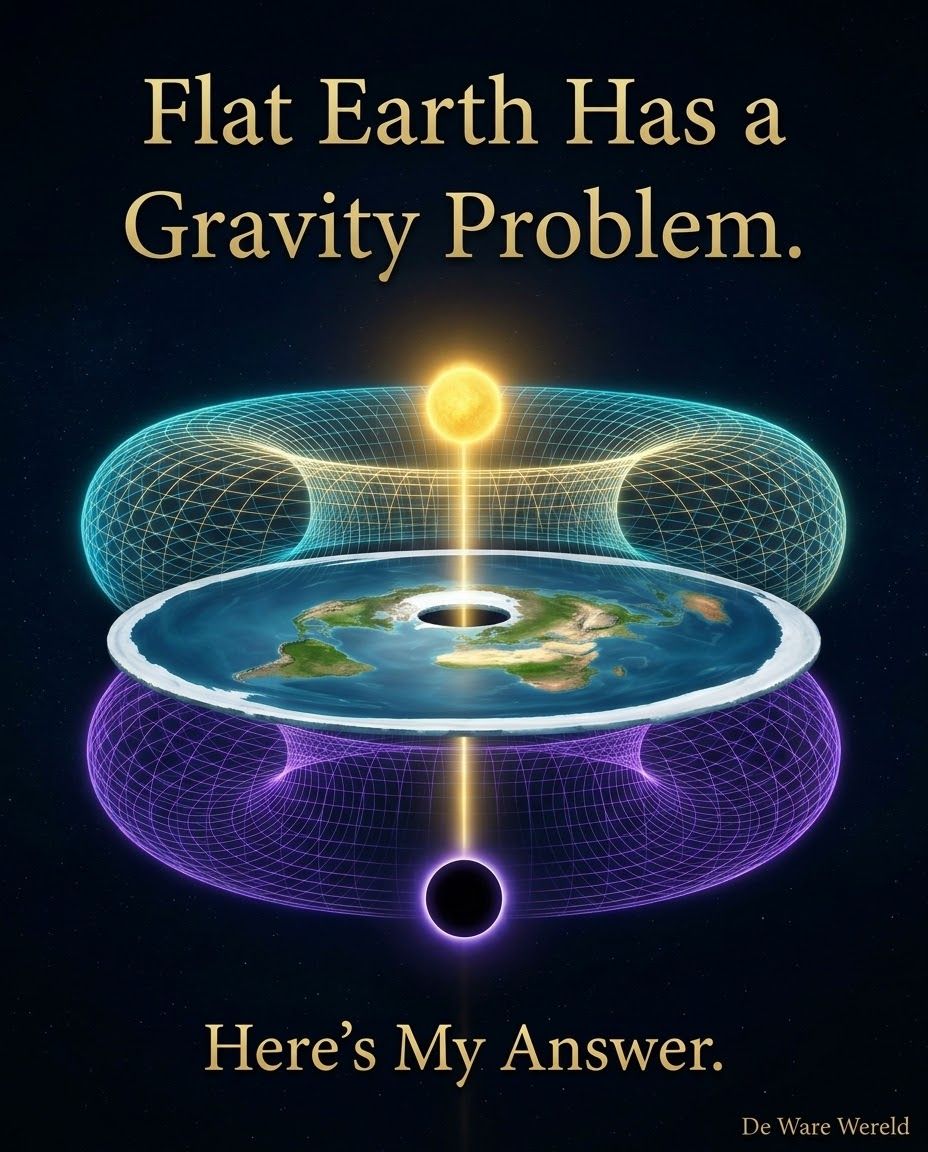
In short: every flat earther gets the same question sooner or later: if there is no ball, why do we fall down? In this article I share my answer. Our world as a double torus, with the plateau as the boundary between an upper world and an underworld, and gravity as a pull toward that boundary. Not proof, but an idea that holds together within this model.
If you believe, like I do, that we live on a plateau and not on a spinning ball, sooner or later you run into a tough question: why do we fall down? At school we learned that gravity pulls everything toward the center of the globe. But if there is no globe, what does it pull toward?
Within the flat earth community the usual answer is density and buoyancy: heavier things sink, lighter things rise. There is a lot of truth in that. But it leaves one question open. Why is there a “down” in the first place? Why does the heavier object sink downward, and not sideways? Something has to set the direction. I have been thinking about that for a while, and I want to take you along in my reasoning.

Two worlds, one boundary
In my view our world is a double torus. We live on the plateau, the middle layer. Above us is the upper world with our sun. Below us lies the underworld, with the Black Sun as the counterpart of our sun. The channel through the middle is the North Pole. So the plateau is not just a loose piece of land. It is the boundary between two worlds.
I wondered what happens where those two worlds “touch”. My first thought was magnetism. Two magnetic fields pushing against each other really do form a flat surface between them. But magnetism only pulls on iron and similar materials, not on wood, water or people. So that could not be it.

Every atom a tiny rod
Then I came across the Electric Universe thinkers. They say gravity is a very weak electrical effect. Every atom has a positive core with negative particles around it. When those get slightly out of balance, every atom becomes a tiny rod with a plus side and a minus side. Billions of those rods together create a pull that works on everything, not just on metal.
This is where it gets interesting for me. If the upper world and the underworld are electrically different, all those atoms line up toward the boundary between them. Then the pull points straight down everywhere, exactly what you would expect on a flat plateau. And it gives density and buoyancy the direction they need.

What this would mean
- Higher means weaker. The further you get from the plateau, the weaker the pull. That is what we actually measure.
- The North Pole is different. Where the channel between upper and lower world is, the pull should behave differently. Maybe that explains why Admiral Byrd experienced his journey so strangely.
- As above, so below. Whoever lives in the underworld is pulled toward the plateau from the other side. Their down is our up.

The other side
Physicists say this electrical explanation has never been worked out well enough to calculate satellite orbits with, something regular gravity theory can do. And objects made of completely different materials fall equally fast, while you might expect a difference with an electrical force. That is a fair point.
Still, I think it is worth thinking about. Because who decides which questions we are allowed to ask? I am curious what you think. Does this close the gap, or does it open new questions?
De Ware Wereld is a Dutch website about alternative history, the flat earth and our world as a virtual reality. Most articles are in Dutch; Chrome can translate them for you. Join the conversation on Telegram.
Geef een reactie